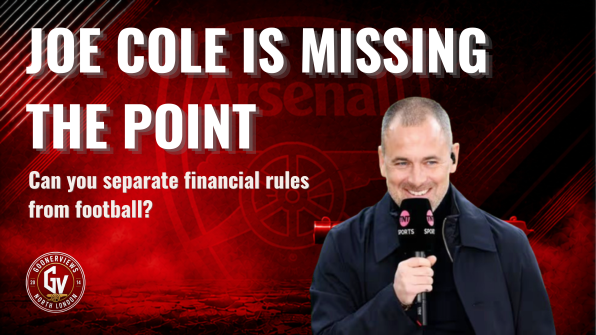
Joe Cole’s line about “levels of cheating” caused noise because it sounded clumsy. The bigger problem is the logic. It tries to separate the football from the conditions that produced it.
Manchester City have been found guilty by an independent Premier League commission of serious financial breaches across nine seasons. The commission found sham commercial arrangements, misstated accounts and significant breaches of spending limits. City deny wrongdoing and have appealed. Until that appeal is finished, the process is still live.
Cole accepted that City should be punished if the verdict stands. His dividing line came somewhere else. He said doping and referee manipulation sit at a different level and argued that “the only pure thing about football is what happens on the pitch”. He does not believe City’s achievements should be treated as tainted in the same way as match fixing.
The comparison with match fixing is a distraction.
Nobody needs to claim financial rule breaking is identical to bribing a referee. The relevant question is whether the rules governing how a team is financed affect what happens on the pitch. Of course they do. That is why the rules exist.
Players do not arrive from nowhere on Saturday afternoon. Wages matter. Transfer fees matter. The ability to keep elite players instead of selling them matters. Commercial income changes what a club can spend and what losses it can absorb. If a club is found to have distorted that system, kickoff does not suddenly wash the advantage clean.
Arsenal supporters understand the emotional version of this better than most. They watched teams under Arteta chase Manchester City to title races decided by tiny margins. The argument was always that Arsenal had to become almost perfect because City could stack elite seasons together with a depth of talent few clubs could match.
The commission’s findings concern conduct between 2009 and 2018, and City are appealing them. Nobody can responsibly take the ruling and rewrite every later season with a marker pen. Competitive advantage compounds, though. Squad value compounds. Commercial scale compounds. Winning itself creates more winning power.
That is why Cole’s attempt to isolate “what happens on the pitch” feels so artificial.
His Chelsea background is interesting here, but it needs care. Cole joined Chelsea in 2003, weeks after Roman Abramovich bought the club, and spent seven years inside the team that changed English football’s relationship with owner wealth. That does not prove bias. It may explain why the idea of huge external financial power feels less morally dramatic to him than it does to supporters whose clubs had to compete against it.
Chelsea were not Manchester City and the cases are not the same. The cultural shift matters. A generation of English football grew used to treating ownership money as scenery while judging the football as a separate product.
The City case makes that separation impossible if the verdict survives appeal.
Martin Keown’s anger in the TNT debate came from the opposite place. For him, rules only matter if breaking them changes the sporting consequence. You can argue about the correct punishment. You can argue about titles, points, fines or relegation. Those are sanction questions.
Cole’s claim goes deeper because it asks us to believe the football itself remains untouched.
I cannot get there.
If financial rules are designed to regulate the resources used to build a team, then serious breaches of those rules belong inside the sporting story. They do not become accounting trivia because Haaland still has to finish the chance himself.
Arsenal spent years being told the answer to City was simple. Get better. Recruit better. Coach better. Take more points.
That demand only makes sense if everybody is working inside rules that mean something.
There may be levels of cheating. There are not levels of reality. The money and the football meet on the same pitch.
Gerry G – Goonerviews