Sp**s gross spending could approach £400m if the Manchester City double lands. The bigger gamble is how completely the squad has been bent around Roberto De Zerbi’s football.
Sp**s have spent this summer as if the last two years were an accounting error that can be corrected by direct debit.
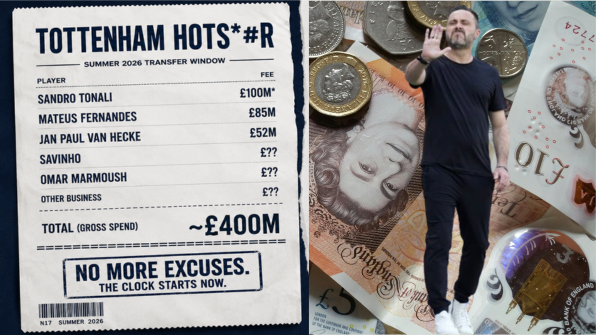
That sounds flippant until you look at the scale of it. After consecutive 17th-place finishes, the Lewis family told supporters in May that the situation could not happen again and promised deeper investment. Sp**s have followed through. Sandro Tonali arrived in a deal worth up to £100m. Mateus Fernandes cost £85m. Jan Paul van Hecke was £52m. The Guardian now reports agreements are close for Savinho and Omar Marmoush, deals that would take the club’s gross summer spending close to £400m.
The easy joke is Rottenham spending Champions League money after finishing one place above relegation twice. The more interesting point is what they have actually bought.
For Arsenal supporters, the temptation is to treat the fees as evidence Sp**s are panicking. That is too easy. Tonali was admired by Arsenal and Manchester City, and Savinho has the one-on-one threat elite teams keep chasing. Rottenham have bought good players. The concern is the premium paid and the amount of the squad now tied to one coach’s football.
This is a squad built around Roberto De Zerbi’s football with almost no attempt to disguise it.
Van Hecke played his best football under De Zerbi at Brighton. He is aggressive stepping into midfield, comfortable receiving with pressure coming towards him and happy defending 40 yards from his own goal. Tonali gives De Zerbi a midfielder who can receive on the wrong side of an opposition press and still move the ball forward. Fernandes adds the running and carrying around him. Sp**s own numbers from last season at West Ham had Fernandes joint-fifth in the Premier League for tackles with 103. The pattern is coherent. The midfield has been designed to survive the type of risks De Zerbi wants his teams to take in possession.
Savinho and Marmoush would complete the picture. De Zerbi needs width that can eliminate a defender and a forward who can attack the space created when opponents jump to his build-up. Savinho can hold the touchline and beat the first man. Marmoush can threaten the channel before a defence has reset. If both arrive, Rottenham will have spent heavily on players whose value makes most sense inside the manager’s preferred game model.
That is where the real risk sits.
Clubs normally protect themselves from a coach leaving by recruiting players who survive the next manager. Rottenham have gone the other way. Tonali is good enough for almost anyone, but the concentration of spending around De Zerbi’s needs is obvious. Van Hecke is a reunion. Fernandes cited the manager as a major reason for joining. Tonali spoke about a long conversation with De Zerbi before choosing Sp**s. The football department has handed the head coach unusual power to define the rebuild.
There is logic to that after years of drift. Rottenham spent too long collecting players for different managers, different structures and different versions of what the club thought it wanted to be. A clear idea is better than a compromise squad.
Clarity becomes exposure when the bill gets this high.
Rottenham have also moved serious assets out. Cristian Romero has gone to Atletico Madrid. Djed Spence joined Inter. Luka Vuskovic, the highly regarded Croatia centre-back, was sold to Brighton for a deal worth up to £50m before playing a competitive minute for Sp**s. Those exits reduce the net cost, which matters, but they also make this more than a spending spree. Rottenham are exchanging future optionality for a team they expect to work now.
Even the age profile tells you the same thing. Tonali is 26. Van Hecke is 26. Andy Robertson is 32. Marcos Senesi is 29. Savinho and Fernandes give the window some youth, but Rottenham are behaving like a club buying readiness rather than patiently collecting value.
That changes the standard De Zerbi should be judged against.
A seventh-place finish would normally look like major progress from 17th. After this window, it should feel underwhelming. Rottenham have a stadium that generates elite revenue and an ownership group now willing to put capital into the team. The old complaint was that the football operation never matched the financial machine. That complaint has lost its force.
There is still a coaching problem to solve. De Zerbi’s football can be devastating when the spacing is right, but it asks defenders and midfielders to accept ugly moments as the price of drawing pressure. Better players reduce those moments. They do not remove them. If Rottenham lose the ball with both full-backs high and Tonali dragged towards the first line, Van Hecke and Micky van de Ven will still be asked to defend huge spaces. £400m does not make the system safer by itself.
It does remove ambiguity.
For years, Rottenham could argue about whether the manager had been backed, whether the squad fit the coach, whether the wage structure was holding them back. By September, De Zerbi should have a squad shaped in his image and funded at a level few managers ever receive.
If the Manchester City double is completed, close to £400m of gross spending makes Champions League contention the minimum credible return on De Zerbi’s first full season.