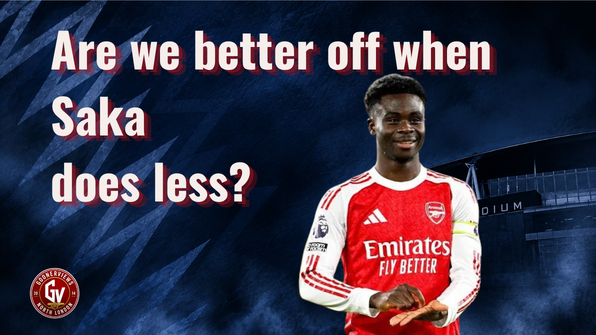
Bukayo Saka has spent years being Arsenal’s emergency exit. The strange thing about this version of Arsenal is that they may finally be good enough to stop using him like one.
Watch the opening weeks again and the most encouraging Saka moments are not always the ones where Arsenal funnel possession towards him until he has to beat two defenders. Against Coventry, Christos Tzolis caused damage from the other side almost immediately. Tzolis and Riccardo Calafiori combined to create Kai Havertz’s opener, then Tzolis drove another delivery across the box for Saka’s goal. Saka finished the move. He did not have to manufacture it.
That distinction matters.
For most of Arteta’s rise, Arsenal’s right side has carried an absurd amount of the attacking intelligence. Saka receives. Martin Odegaard arrives underneath him. The right back supports or underlaps. The opposition shifts across because everybody knows where the next problem is coming from. Arsenal have still been good enough to make that predictable pattern work, but predictability has a physical cost. Saka is asked to receive under contact, protect the ball, create separation and then produce the final action.
The early version of Tzolis changes the geometry. He wants to come inside and hurt the box rather than decorate the touchline. Calafiori does not behave like a conventional left back behind him. He can appear inside, outside or beyond the winger. Against Aston Villa, the winning move began on that side after Eberechi Eze spotted Calafiori’s underlap. Calafiori crossed and Saka arrived to finish. Again, the goal belonged to Saka without the attack depending on Saka.
That is the model Arsenal should chase.
There is a temptation with elite players to increase their involvement because they are elite. Give Saka more touches. Find him earlier. Build more combinations around him. I think Arsenal should be trying the opposite. Give him fewer ugly touches and more decisive ones.
A winger receiving 40 yards from goal with a full back tight to him and a second defender waiting inside is technically involved. He is also being asked to solve the hardest version of the problem. Arsenal should want Saka receiving after the defence has already moved, after somebody on the left has forced a midfielder to turn, after Havertz has dragged a centre back out, after Calafiori has occupied a player who would otherwise be doubling up.
Chelsea offered another glimpse. Arsenal went behind almost immediately, yet they did not spend the next hour desperately feeding the right wing. Havertz drifted across the front. Tzolis carried threat from the left. Odegaard kept arriving higher. Saka still mattered, but the attack had other places to breathe.
Brighton showed why the idea is unfinished. When Arsenal lost control at the Amex, the left side did not rescue them. Tzolis wasted a rare break. Brighton’s press stopped Arsenal establishing the platform that lets the two wings threaten at different moments. Saka then had one of Arsenal’s clearest chances before half time and could not convert it. Old Arsenal returned because the rest of the attack had stopped functioning.
Arteta’s answer should be to protect the new balance when a game becomes ugly, rather than pushing the ball back towards Saka every thirty seconds.
Saka is 25 and already has the mileage of a player several years older. Arsenal do not need to protect him by making him passive. They need to protect him from low-value responsibility. Let Tzolis start attacks. Let Calafiori distort the left side. Let Odegaard attack the box. Let Havertz occupy centre backs. Then let Saka arrive against a defence that has finally had to look somewhere else.
The best version of Saka may have fewer touches than the one Arsenal have spent years celebrating. If that sounds like reducing his importance, look again. It is Arsenal finally becoming good enough to stop asking their best winger to do everybody else’s job.
Gerry G – Goonerviews